





For much of the past decade, digital transaction management has been viewed primarily through the lens of efficiency. Organizations adopted electronic signatures, workflow automation, and digital document exchange technologies to eliminate paper, accelerate approvals, reduce operational costs, and improve customer experiences. The business case was straightforward: move transactions faster, reduce friction, and create a more agile enterprise.
Yet beneath these advancements, a more fundamental shift has been occurring - one that is now reshaping how business leaders evaluate digital transaction management platforms.
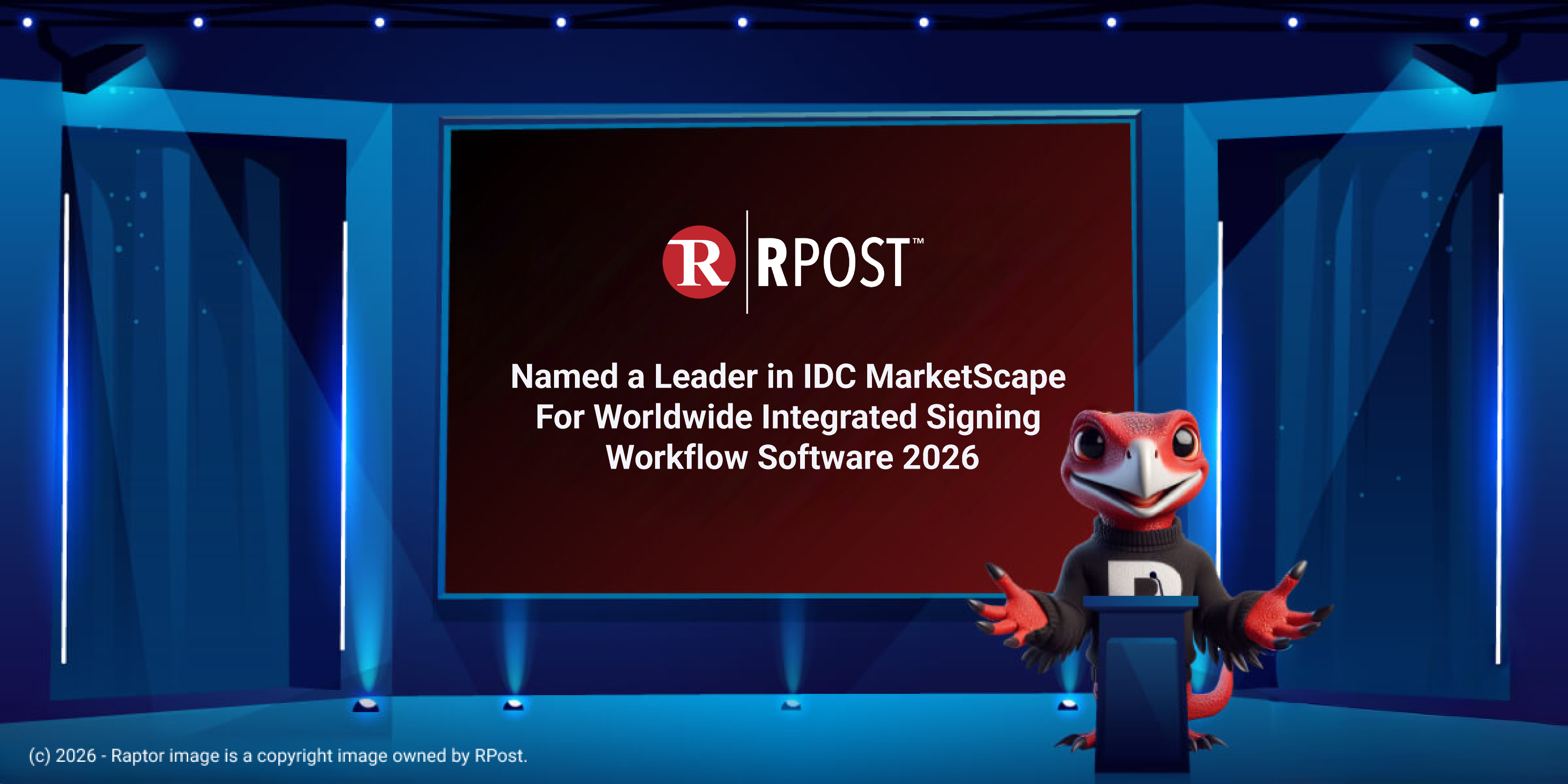
Hey, Rocky the Raptor here, RPost’s cybersecurity product evangelist. Those concerned with protecting strategic company data know that the documents that power modern business processes today have become among the most valuable intelligence assets available to cybercriminals.
For example, contracts can reveal relationships; invoices, payment patterns; purchase orders, supply chains; banking instructions, movement of funds; approval workflows, organizational hierarchies; and customer agreements reveal communication patterns and trusted contacts.
Taken together, these seemingly routine business documents form a detailed blueprint of how an organization operates. And to a cybercriminal, that blueprint is invaluable.
The rise of AI has dramatically accelerated this reality. Attackers no longer need weeks or months of manual reconnaissance to understand a target organization. AI-powered systems can analyze documents, transaction histories, communication patterns, and business processes at unprecedented speed, enabling BEC and wire fraud campaigns that are more personalized, more convincing, and more difficult to detect than ever before.
As organizations invest in AI to improve productivity, cybercriminals are leveraging the same technologies to enhance deception – Gartner Research calls this the dawn of DarkAI. The result is a new generation of business email compromise attacks, supplier impersonation schemes, invoice fraud campaigns, and wire-transfer diversion attempts that increasingly rely on detailed contextual intelligence gathered long before the actual attack occurs.
As Aragon Research proclaims in its just released Globe for Digital Transaction Management report (download here) –– which by the way I am pleased to report RPost with its RAPTOR™ AI was named a Worldwide Leader with the Highest Innovation scores among all considered -- this evolution is forcing enterprise leaders to rethink the role of digital transaction management itself. Historically, the objective was transaction execution; organizations wanted to ensure documents were signed, delivered, tracked, and archived efficiently in compliance.
Increasingly, however, the challenge extends far beyond execution. Now, it’s no longer whether a transaction can be completed digitally, but whether the platform managing that transaction can recognize when someone is attempting to weaponize the information contained within it. This distinction may define the next era of enterprise software.
In many ways, digital transaction management sits at the intersection of business operations and cybersecurity. Yet while organizations have invested heavily in protecting networks, endpoints, and identities, they have often had limited visibility into how transaction content itself is being accessed, analyzed, and potentially exploited.
This gap is becoming increasingly difficult to ignore. Cybercriminals understand that successful fraud rarely begins with the fraudulent payment request itself. The most effective attacks are built upon a foundation of reconnaissance by studying organizations, observing behavior, learning approval chains, identifying trusted relationships, and analyzing transaction timing and communication patterns. Only after gathering sufficient intelligence, they launch the actual fraud attempt, and by then, the damage may already be underway.
What makes this challenge particularly significant is that traditional cybersecurity tools are often designed to identify attacks in progress. They excel at detecting malicious activity once adversaries have begun acting. But the next frontier lies in identifying suspicious behavior before the attack unfolds.
In effect, digital transaction platforms are beginning to evolve from passive systems of record into active systems of cybercriminal intelligence.
According to RPost CEO Zafar Khan, customer expectations are changing rapidly in response to these realities. "We at RPost understand that our customers the world over are not only looking for feature richness, elegantly easy interfaces, advanced workflow automation, more affordability, and friendlier people to work with in their eSignature and digital transaction management products, but now also for intelligent AI-infused security."
His observation reflects a broader market transition. Organizations are increasingly refusing to choose between usability and protection. They expect platforms to deliver both simultaneously. Business leaders want frictionless digital experiences, but they also recognize that every transaction creates potential exposure. The challenge is not merely enabling business processes; it is protecting the intelligence embedded within those processes.
That philosophy has informed RPost's development of RAPTOR™ AI, an AI-powered security and automation framework designed specifically for digital transaction environments. As Khan explains, "Digital transaction content is a honeypot for cybercriminal context gathering pre-strike. We've infused agentic AI automation, arming our customers with the ability to see cybercriminals engaging in their reconnaissance before they begin their GenAI-powered-up impersonation schemes to create financial chaos."
In this emerging model, the most valuable enterprise applications may not be those that merely automate tasks. They may be those that can recognize when a process is being manipulated and intervene before a business disruption occurs.
Khan continues, "With RPost's RAPTOR™ AI booster for digital transaction management security and automation, RPost can intelligently pre-empt the crime from building, auto-locking content that would otherwise be used in clever supplier, invoice, BEC, or other payment and wire fraud schemes."
Security increasingly must be embedded directly into the transaction lifecycle itself.
As digital transformation continues and AI reshapes both enterprise productivity and cybercrime, organizations will increasingly evaluate digital transaction management platforms through a different lens. Workflow automation, user experience, integrations, and compliance will remain essential, but they will no longer be sufficient on their own.
The platforms that define the next decade will be those capable of combining automation, intelligence, compliance, and security into a unified operational framework. And that is why RPost’s recent industry recognition carries particular significance. The recognition reflects more than product functionality; it underscores a broader industry movement toward intelligent, AI-infused transaction management platforms capable of helping organizations not only accelerate business processes but also proactively defend them (Read more on this here).
The recognition reflects more than product functionality. It underscores a broader industry movement toward intelligent, AI-infused transaction management platforms capable of helping organizations not only accelerate business processes but also proactively defend them (Download report).
That future is arriving faster than many organizations realize, and Aragon Research's decision to name RPost a Leader with the highest innovation score in Digital Transaction Management may be one of the clearest signals yet of where the market is headed.

October 09, 2026

October 01, 2026

September 25, 2026

September 18, 2026
September 16, 2026







 Blog
Blog